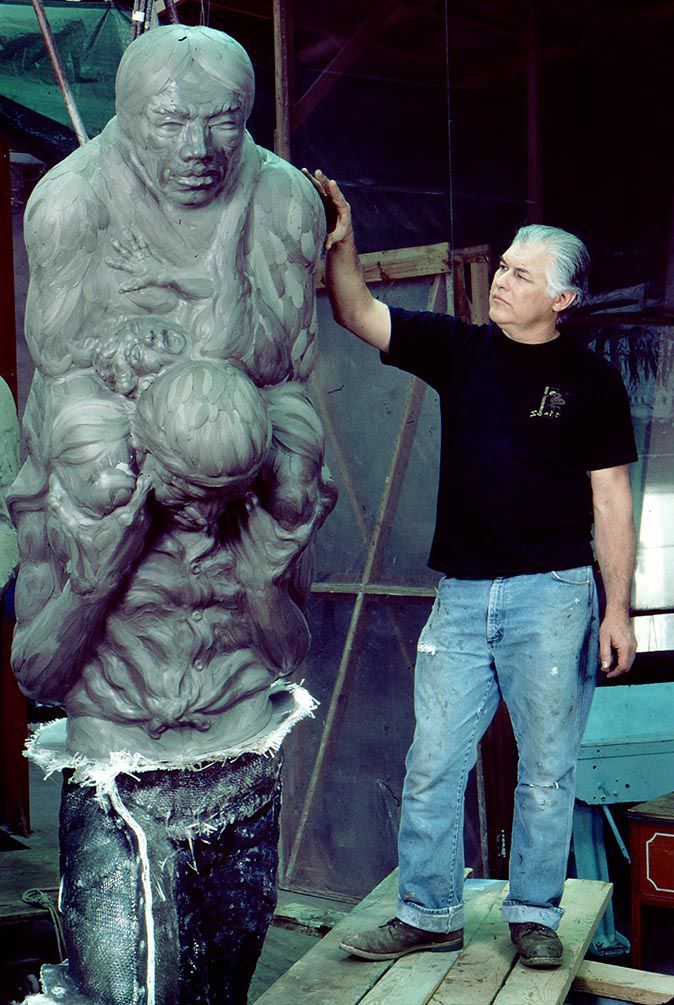
Luis Jiménez – Monumental Resilience
Early Life and Artistic Beginnings
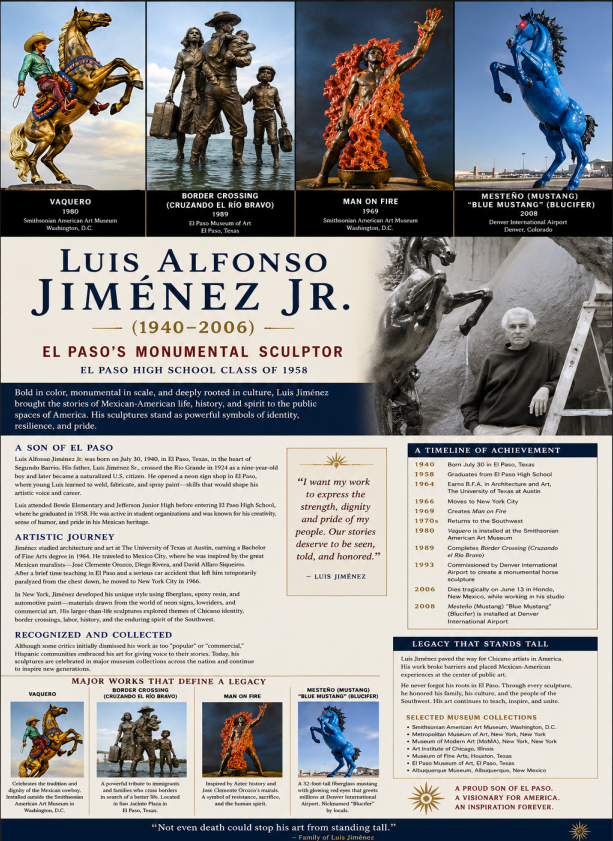
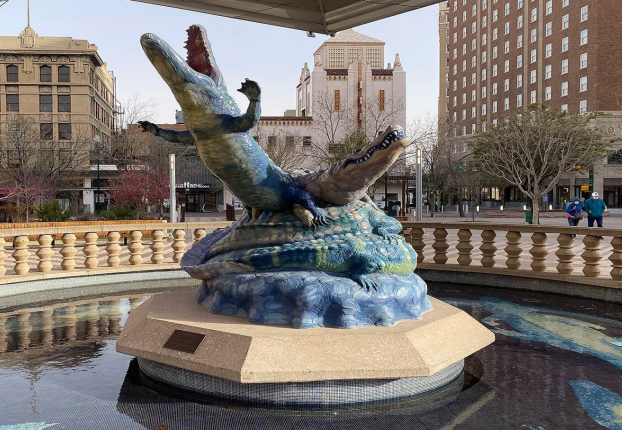
Luis Alfonso Jiménez Jr. was born on July 30, 1940, in the heart of El Paso, Texas’s Segundo Barrio. His artistic voice was shaped early on by his father, who had crossed the Rio Grande as a nine-year-old boy in 1924 and later opened a celebrated neon sign shop in El Paso. Working in his father's shop from the young age of six, Luis learned welding, fabrication, and spray-painting techniques—skills that would ultimately define his monumental public art career. As a child, he also frequently visited San Jacinto Plaza with his mother to watch the live alligators that lived there, creating a bank of local memories that would later inspire one of his most beloved hometown projects.
Education and Formative Influences
After attending Houston & Lamar Elementary Schools, Jimenez entered El Paso High School, where he graduated in 1958. Throughout his school years, he was widely recognized for his creativity, sharp sense of humor, and deep pride in his Mexican heritage. He went on to study architecture and art at the University of Texas at Austin, earning his Bachelor of Fine Arts degree in 1964. Eager to expand his artistic perspective, Jiménez traveled to Mexico City, where he found profound inspiration in the powerful murals of Diego Rivera, José Clemente Orozco, and David Alfaro Siqueiros, while also drawing inspiration from regional figures like Tom Lea and Urbici Soler.
Artistic Journey and National Recognition
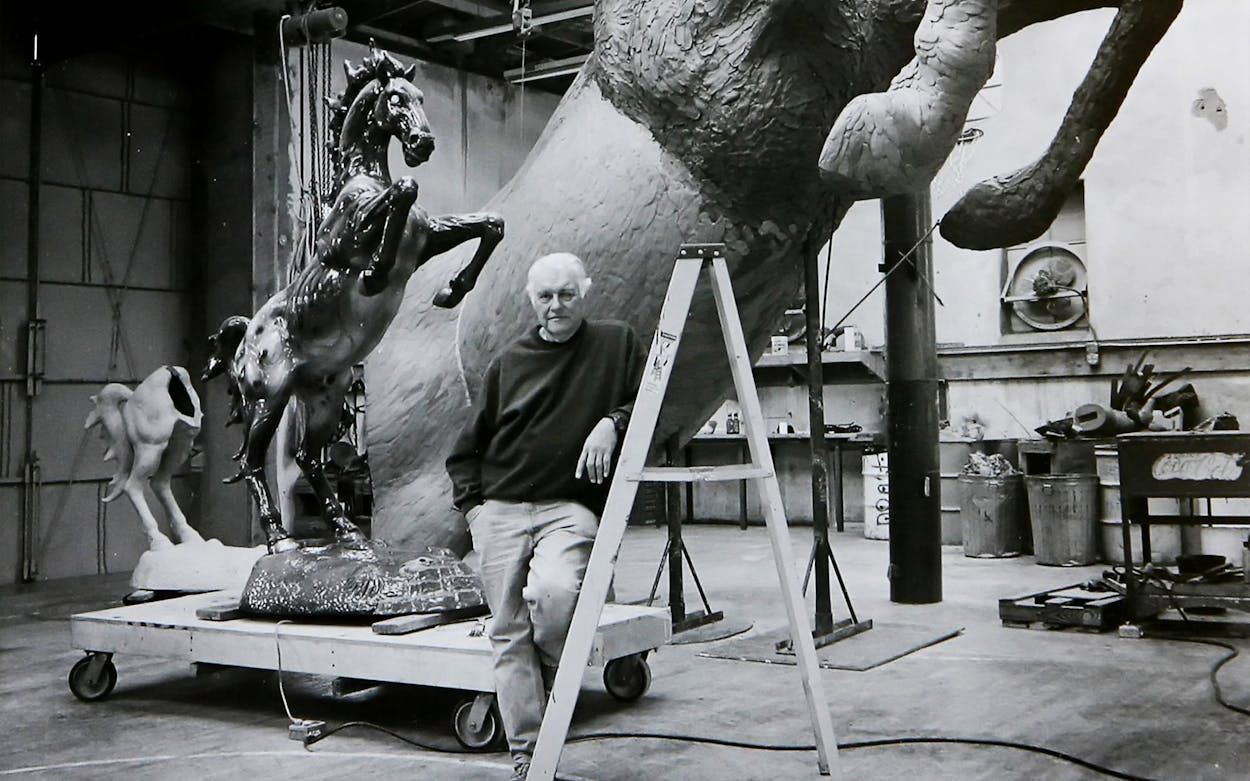
Following a brief teaching period in El Paso and a serious car accident that left him temporarily paralyzed from the chest down, Jiménez moved to New York City in 1966 to pursue his career. It was in New York that he developed a revolutionary approach to large-scale public sculpture. Utilizing fiberglass, epoxy resin, and automotive paints, he repurposed commercial materials from the worlds of neon signs and lowriders into high art. He achieved his first major New York gallery success in 1969 with pieces like Man on Fire. By the 1970s, he returned to the American Southwest, dedicating his larger-than-life sculptures to celebrating Chicano identity, working-class communities, labor, and the realities of border life. Though some critics initially dismissed his work as "popular" or "commercial," Hispanic communities strongly embraced his art for giving an authentic voice to their lived experiences.
Major Honors and Later Career
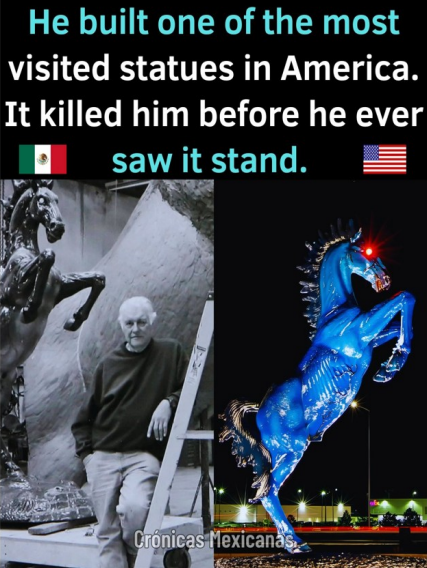
Over the decades, Jiménez produced several monumental works that cemented his legacy across America. In 1980, his famous sculpture Vaquero was installed outside the Smithsonian American Art Museum in Washington, D.C., honoring the dignity of the Mexican cowboy. In the 1980s, he was commissioned by the El Paso Art Alliance to honor his own childhood memories by creating Los Lagartos, a permanent fiberglass tribute to the historic alligators of San Jacinto Plaza, which was proudly dedicated in June 1995. In 1993, he received a major commission from Denver International Airport to build a massive, 32-foot-tall bucking horse sculpture. Tragically, on June 13, 2006, Jiménez died in his Hondo, New Mexico studio when a piece of this monumental work, Mesteño (popularly known as Blue Mustang or Blucifer), struck him during its creation. The sculpture was completed by his family and studio, and it was officially installed at the airport in 2008. Today, his pieces are celebrated in premier museum collections nationwide, including the Metropolitan Museum of Art, the Museum of Modern Art (MoMA), and the Art Institute of Chicago.
Philosophy
Throughout his groundbreaking career, Luis Jiménez paved the way for Chicano artists by pushing Mexican-American stories into the center of American public art. He summarized his lifework with a proud mission statement: "I want my work to express the strength, dignity and pride of my people. Our stories deserve to be seen, told, and honored". Reflecting on his enduring impact, his family beautifully remarked that "not even death could stop his art from standing tall".